Do Miniature Cows Produce Good Beef?
Meat From Minis
Pint-sized cattle provide country-efficient beef.
By Callie Leuck

An unusual herd of cattle graze in Virginia's Shenandoah Valley. They are all less than three and a one-half feet alpine and almost every bit wide as they are wide — similar "barrels on legs," said Rob Clements when nosotros met on his belongings, Misty Meadows Farm, a few miles off Exit 235 on Virginia'southward I-81. Miniature cattle have gotten attending of late mostly every bit novelty pets — particularly for people with little country who desire to keep livestock — but they are also an efficient way for a farmer to raise meat.
Clements began breeding miniature cattle well-nigh by accident. While raising full-sized Galloways, he found one of his cattle was on the small side. When he bred it with another small-scale Galloway, the resulting dogie was so small that Clements was concerned. Then he discovered at that place are people who are intentionally raising and breeding miniature cattle.
These smaller cattle are being bred for ii chief reasons: they are easier to handle, and they require less land per acre, says the International Miniature Cow Breeders Society (IMCBS). Two full-sized cattle need 5 acres, while two miniatures need just two acres.
The IMCBS and a registry that tracks xx-six miniature cattle breeds are run by Happy Mountains Miniature Cattle Farm, a Seattle-based system started over 30 years ago by the late Richard Gradwohl. His organisation developed eighteen breeds of miniature cattle by crossing various total-size breeds with smaller cows until they "bred true." " 2 animals of the aforementioned variety "breed true" when they produce consistent, replicable, and predictable offspring.
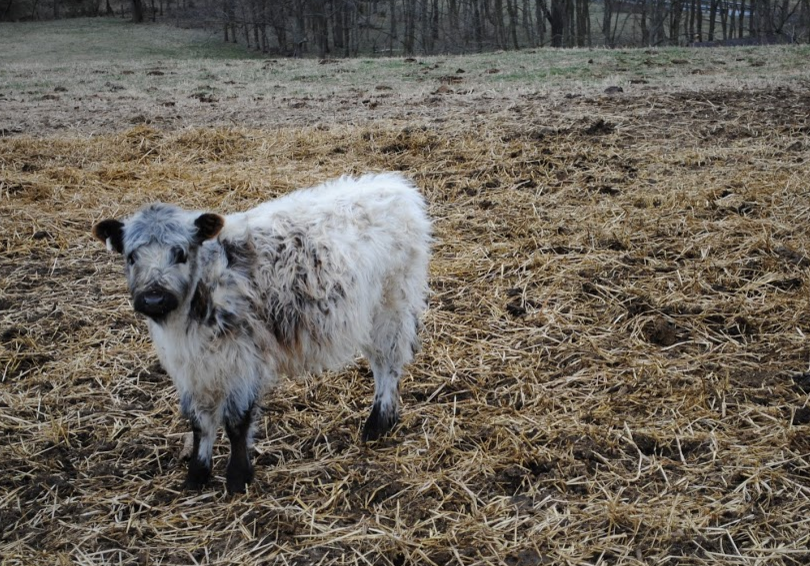
Still, miniature cows are not mutual. Clements' subcontract is i of the few places in Virginia that breeds minis at all, and unlike the new amalgamated breeds of miniatures at Happy Mountains, Clements's herd is purebred Galloway - unusual in the US. Clements' miniatures are registered alongside normal-sized cattle on the US Galloway registry; in that location is no dissever registry for miniature Galloways.
In Australia, Galloway miniatures are more mutual. An official Australian Miniature Galloway registry provides the criteria: less than 50-pound birth weight and no more one hundred five centimeters (iii and forty-iv-hundredths feet) at the pinnacle of the back at eleven months. Clements has advisedly cultivated his cattle's genes to come across the criteria for miniature Galloways, picking upward more small Galloway bulls over time. All the animals in his herd, which contained forty-iii animals in 2011, see the Australian criteria.
According to the IMCBS, total beef production per acre is significantly greater when raising miniature cattle. Clements institute he was able to produce more than beef per acre when he switched to minis. Indeed, his pounds per acre doubled. Because the miniatures have a smaller trunk frame and size to maintain, they also have a better feed efficiency. Clements agreed with the IMCBS that miniature cattle are easier to handle, and added he had noticed they tend to be more docile than their larger counterparts.
Why then, if these smaller cows are so much more than efficient to raise, are they not commonplace? Why aren't all American hamburgers fabricated from miniature cattle?

"You can't sell them on the article marketplace!" Clements explained. "The packing plants want large. They want a big cow to put on a claw."
The bulldoze for large cattle began after World State of war Ii, when Americans migrated to cities and demand for meat began to rise. Earlier this, most cattle were smaller, much closer to the size of new miniature breeds today. But every bit demand for meat rose, need for large cattle rose too.
I miniature breed that Richard Gradwohl adult for beefiness production at Happy Mountains "never took off likewise as the beautiful minis for pets," said his girl Michelle Gradwohl. She added that it would exist difficult to persuade all the ranchers who raise total-sized cattle for beef production to switch to miniature cattle.
Still, miniatures could appeal to a niche market. Aside from their high efficiency, miniature cattle likewise avowal superior beef. In an commodity on his website, Richard Gradwohl wrote that the shorter jail cell structure in miniature cattle naturally leads to tender meat. Large cattle have long, slender cells that tend to be tougher; they are therefore fed grain to fatten them up and "marble" the beef, creating pockets of fatty throughout the meat. "This results in many undesirable effects from feeding cattle grain and hormones to make them gain faster," Gradwohl wrote.
Clements suspects the flavor has more to do with the departure betwixt how individual farmers enhance grass-fed miniature cattle compared to how larger cows are raised in factory farms, than with the cell structure. Additionally, as many of the new miniature cattle breeds were developed by mixing breeds, they may have characteristics from those dissimilar breeds that could event in a unique-tasting beef. After all, "different breeds have [different] flavors," according to Clements.

In his feel, beef from his miniature Galloways maintains the Galloway beefiness's reputation for great flavor. Galloway cattle accept a double hair glaze that reduces the demand for internal fat for warmth, making purebred Galloway beef lean and juicy. Its flavour is noticeably dissimilar from Angus beef, which is the virtually common commercially available beef in the U.s.. The flavour of the miniature Galloways may besides be influenced by stress - or rather, lack of stress. Michelle Gradwohl noted in an email that miniatures are usually raised in a calm environment such equally a small subcontract, unlike the larger cattle raised in feed lots. When cattle are stressed, equally they often are in feed lots, they release hormones that give a less highly-seasoned flavor to the meat.
The most noticeable difference in the miniature cattle meat is the smaller size of the specialty cuts. "People don't desire big steaks," Clements said. "Some will cut them up in four pieces for dissimilar meals." For people who don't want gigantic portions, steaks from the minis are reasonable sizes for a single serving. The IMCBS says these smaller cuts are "perfectly suited to the eating house merchandise."
The smaller size of these specialty cuts, combined with the fact that miniatures are currently grass-fed and costless of unnecessary hormones, means that small farmers raising miniatures may detect a specialty market place in restaurants and among individuals interested in land-efficient, and therefore eco-friendly, hormone-free beefiness.

Callie Leuck is a writer and proofreader currently working for a Medicare contractor in Indianapolis, Indiana. She holds a master's degree in science-medical writing from Johns Hopkins Academy. She can be reached at callie@callieleuck.com
Source: http://hawkmoth.us/meat-from-minis

Postar um comentário for "Do Miniature Cows Produce Good Beef?"